













De Minimis Is Now Permanent
What U.S. importers need to do next.
Follow us


What U.S. importers need to do next.
The de minimis exemption is no longer a temporary policy that could quietly return. As of June 2026, U.S. Customs and Border Protection has written its suspension into permanent regulation, and separate legislation locks in a full statutory repeal for every country starting July 2027. For any business shipping into the United States, including India-based exporters and the freight forwarders who move their cargo, this is the moment to treat formal customs entry as the permanent standard, not a temporary inconvenience that might eventually be reversed.
From Executive Order to Permanent Rule
What began as an executive order suspending the eight-hundred-dollar duty-free threshold, first for China and Hong Kong and then for every country, has now been codified through two interim final rules covering non-mail and postal shipments. That distinction matters more than it sounds. Policy made by executive order can shift with a change in administration or a court challenge; a regulation written into the Code of Federal Regulations and backed by statute is built to survive both. CBP's move signals that this is not a negotiating position waiting to be traded away in a future trade deal. Shippers and brokers should plan around formal and informal entry requirements as a fixed, permanent cost of doing business, not a rule that might reverse if political winds shift.
New Deadlines on the Postal Side
The postal channel has its own timeline, separate from commercial ocean and air cargo, and it is easy for businesses focused on container shipments to miss it entirely. A new postal informal entry process took effect in July 2026, with full compliance required by October 2026 for shipments carrying partner government agency data or falling under specific customs chapters that require additional review. A voluntary electronic test for low-value international mail entries begins in September 2026, giving carriers and posts a window to adjust systems before mandatory enforcement follows. Businesses moving goods through postal channels into the U.S., particularly smaller exporters and e-commerce sellers who historically relied on postal shipping for low-value parcels, need to track these dates separately from the commercial cargo timeline or risk shipments getting held at the border with no clear resolution path.
What This Means for Landed Cost
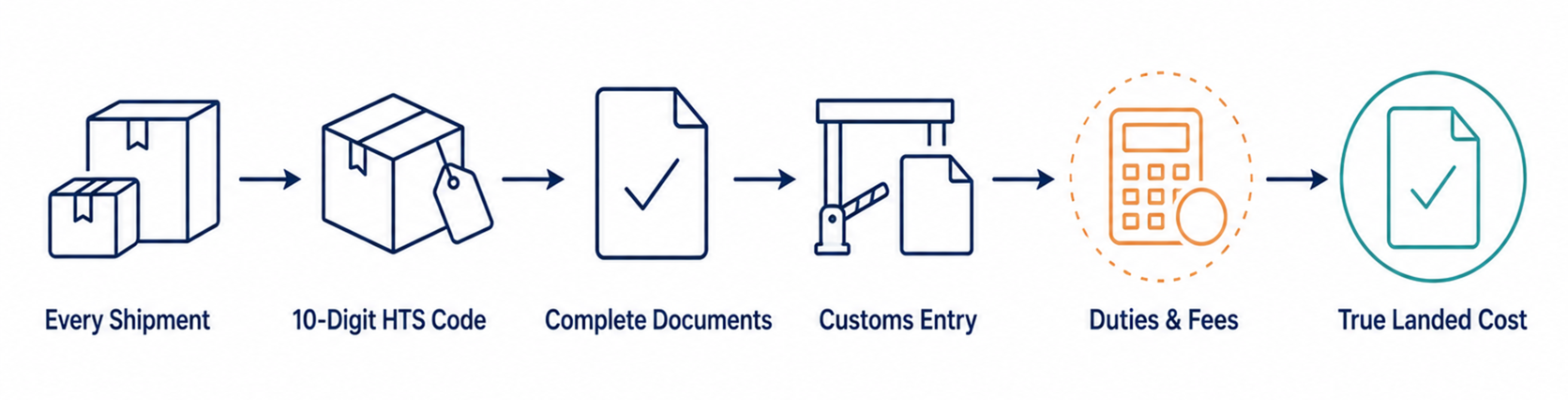
Every shipment, regardless of value or origin, now requires a ten-digit HTS classification, complete supporting documentation, and duty payment through formal or informal entry. There is no longer a value threshold below which a shipment simply clears without scrutiny. Businesses that priced products assuming duty-free thresholds have already seen costs shift, and category-wide price increases have followed as those additional costs pass through the supply chain to end customers. This is not a one-time adjustment either; as enforcement tightens further through 2026 and into the 2027 statutory deadline, the businesses still pricing off old assumptions will find the gap between quoted price and actual landed cost widening rather than narrowing. Getting HTS classification and landed cost calculations right at the quoting stage, before a customer commits to an order, is now a competitive requirement rather than a compliance afterthought handled after the fact.
Why This Hits India-USA Shippers Differently
For exporters and forwarders working the India-USA lane, the practical impact shows up in two places at once: documentation burden and cash flow. Every shipment now needs accurate classification and duty calculation built into the quote, which means the classification step has to happen earlier in the sales process rather than after a customer has already agreed to a landed price. On the cash flow side, duties that were previously avoided entirely on low-value parcels are now a real, recurring cost that has to be built into margin planning rather than treated as an occasional surprise on a handful of shipments.
What Importers Should Do Now
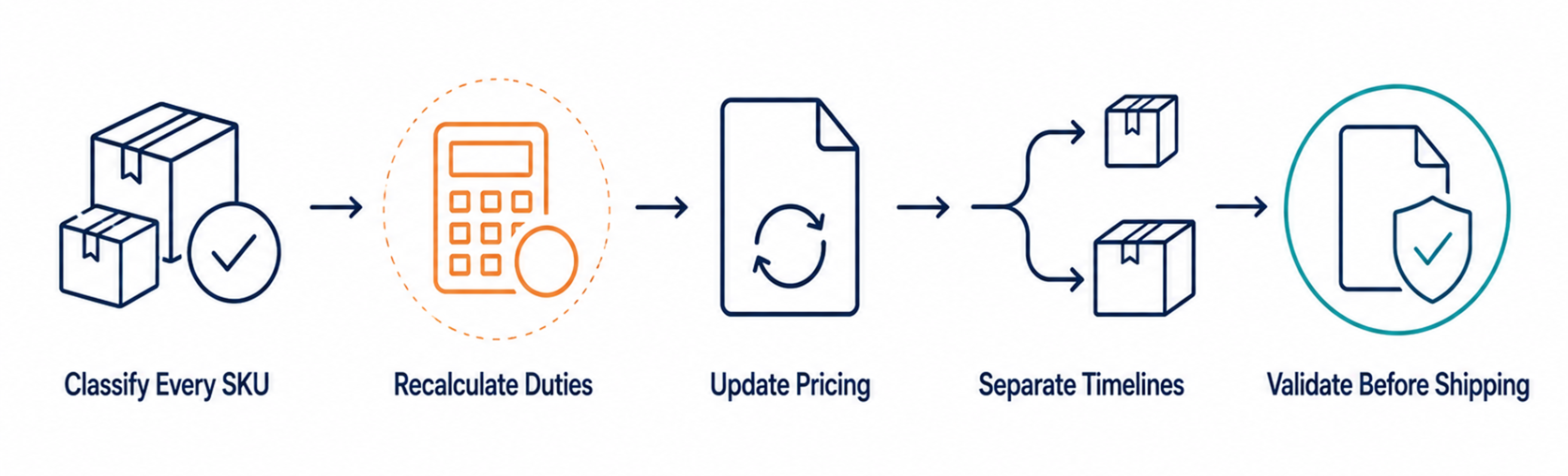
Confirm every SKU has an accurate ten-digit HTS code on file, not a general category classification that may not hold up under review. Rebuild landed cost models to include duties on shipments that were previously duty-free, and revisit customer-facing pricing to reflect the new baseline. Separate postal and non-postal compliance timelines when planning e-commerce fulfillment into the U.S., since the two channels now run on genuinely different schedules. Work with a freight forwarder who can validate entry type and documentation before cargo ships, not after it is already held at the border waiting on paperwork
Get the latest reports, updates and highlights delivered to your inbox.
Get an estimate, or just tell a specialist what you are shipping — we handle everything from there.
Instant vessel schedules from trusted global shipping liners.
FREIGHT WITH SOUL · ON TIME, EVERY TIME
© Atmavaan 2026 · All rights reserved.
 Chat
Chat